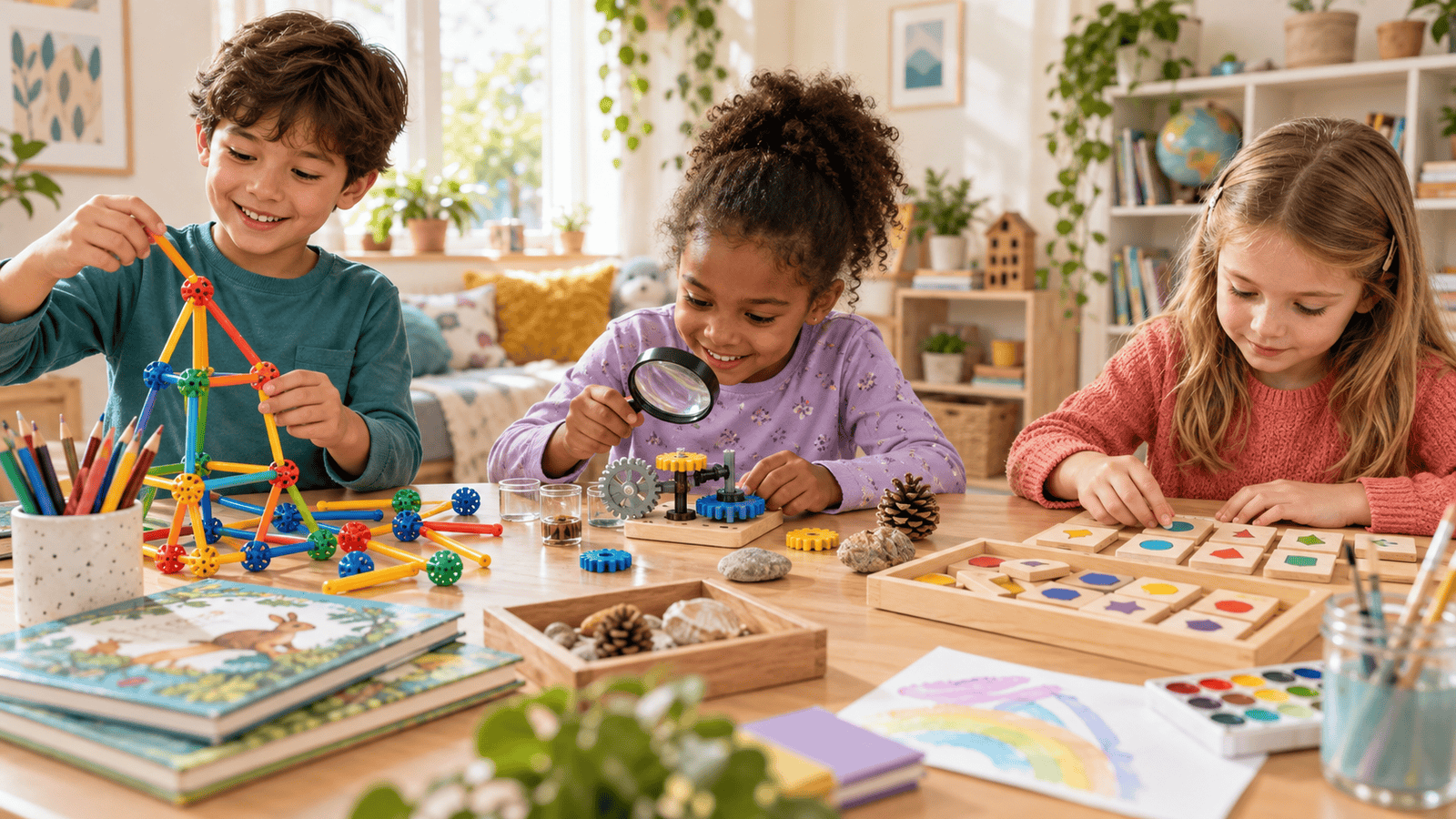
Finding the best educational toys for ages 6 to 8 means choosing activities that combine genuine enjoyment with an appropriate level of challenge. Children in this age group are developing stronger reading, mathematical, problem-solving and social skills, but they still learn best when an activity feels like play rather than schoolwork. A well-chosen educational toy can encourage curiosity, build confidence and keep a child engaged away from a screen.
Six-, seven- and eight-year-olds do not all have the same abilities or interests. One child may enjoy building complicated models, while another prefers experiments, drawing, puzzles or imaginative games. Instead of choosing a toy simply because it is labelled “educational,” consider what the child already enjoys and which new skills the gift could help them explore.
Why the Best Educational Toys for Ages 6 to 8 Make Excellent Gifts
Educational toys can give children a reason to practise important skills voluntarily. Building sets encourage planning and spatial awareness, science kits introduce observation and experimentation, and word games can support vocabulary and communication.
Play-based learning may combine cognitive, physical and social elements. The Education Endowment Foundation reports that play-based learning approaches can have a positive effect on learning outcomes, although it also notes that the available evidence is limited. This is a useful reminder that toys should support learning without being treated as a replacement for teaching, reading or everyday family interaction.
The strongest learning toys usually allow children to make decisions, test ideas and try again when something does not work. They create opportunities rather than dictate a single correct way to play. This makes them useful for independent play, shared family activities and informal learning at home.
Best Educational Toys for Ages 6 to 8 That Develop STEM Skills
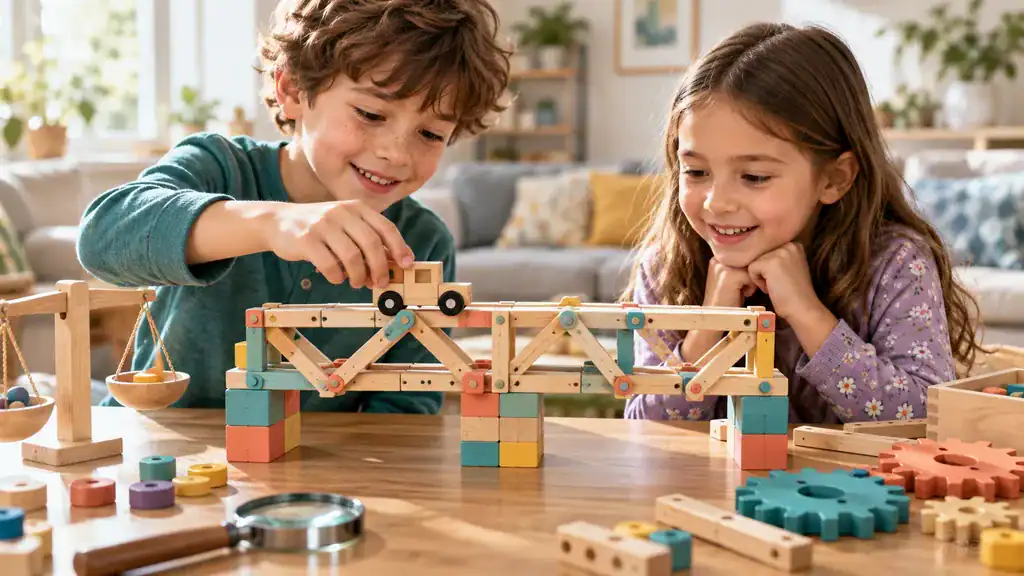
STEM toys introduce ideas connected with science, technology, engineering and mathematics. Suitable choices may include beginner circuit sets, magnetic construction pieces, coding games, microscopes, marble runs and supervised experiment kits.
A good STEM activity should provide clear instructions while leaving room for exploration. For example, a construction kit might show a child how to build one model before encouraging them to invent their own designs. This balance helps children learn a process without limiting their creativity.
Look for activities that produce visible results. Building a working bridge, completing a simple electrical circuit or watching a safe chemical reaction can make an abstract idea easier to understand. Children can also develop patience and resilience when a design needs to be adjusted.
Adult involvement may be necessary for science kits, especially when an activity includes small parts, liquids or electrical components. Always check the age recommendation, instructions and required supervision before giving the toy to a child.
Best Educational Toys for Ages 6 to 8 for Reading and Language
Books are not the only gifts that can support literacy. Storytelling cards, spelling games, word puzzles, magnetic letters and child-friendly reference sets can help children develop vocabulary while playing.
Choose a reading activity that matches the child’s current ability. A game that is far too easy may quickly become boring, while one containing unfamiliar rules and difficult words may feel discouraging. The ideal gift offers a manageable challenge and allows the child to experience regular success.
Story-building games are particularly flexible because children can use pictures, objects or prompts to invent characters and adventures. These activities encourage speaking, listening, sequencing and imaginative thinking. They can work well for individual play or as a shared family activity.
Children who are reluctant readers may respond better to subjects they already love. An illustrated book about space, animals, sport, vehicles or crafts can make reading feel personally relevant rather than compulsory.
Best Educational Toys for Ages 6 to 8 That Build Maths Skills
Mathematical learning toys do not need to resemble worksheets. Strategy games, money-based role-play sets, measuring activities, pattern puzzles and construction toys can introduce mathematical thinking through practical challenges.
Board games that involve counting spaces, comparing scores or managing pretend money can reinforce number skills naturally. Shape puzzles and building sets may support geometry and spatial reasoning, while logic games encourage children to identify patterns and plan several steps ahead.
The most effective maths toys offer different levels of difficulty. A child might begin with a simple puzzle and gradually attempt more complicated challenges as their confidence grows. This gives the toy a longer useful life and reduces the likelihood of it being abandoned after one session.
Avoid placing too much emphasis on speed. Some children need time to consider a problem, and a timed activity can create unnecessary pressure. Cooperative games and open-ended challenges may be better choices when confidence is the main priority.
Types of Learning Toys to Consider
Different categories of educational gifts develop different abilities. A varied selection can help parents and gift buyers find something that suits the child’s personality.
Looking for a present for a special celebration? Explore our guide to the best birthday gifts for ages 6 to 8 for more creative, educational and entertaining ideas.
Construction and engineering toys
Building blocks, model kits, marble runs and mechanical sets can encourage planning, coordination and creative problem-solving. Open-ended construction toys are especially useful because children can follow instructions or design something completely original.
Science and discovery kits
Beginner science kits may explore topics such as nature, weather, space, magnets, crystals or the human body. Choose experiments that use clear instructions and age-appropriate materials. A magnifying glass, bug viewer or basic microscope can also turn an ordinary walk outdoors into a discovery activity.
Coding and logic games
Screen-free coding boards, sequencing games and logic puzzles can introduce computational thinking without requiring a computer. These toys often teach children to divide a problem into smaller steps, identify mistakes and try a different solution.
Creative learning activities
Art sets, craft kits, modelling materials and musical activities can develop coordination, concentration and self-expression. Creative toys work particularly well when they provide enough structure to help a child begin but do not require every finished project to look identical.
For a broader selection of creative, construction and family-play ideas, visit our guide to the best gifts, games and toys for children aged 6 to 8.
Educational board games
Board games can combine learning with conversation and shared family time. Depending on the game, children may practise spelling, mental arithmetic, memory, geography, strategy or cooperation. Check the expected playing time as well as the recommended age; a shorter game may be better for children who are still developing concentration.
For more screen-free activities that develop strategy and social skills, explore our guide to the best board games for ages 6 to 8.
Educational Toy Comparison Chart
| Type of toy | Skills it may support | Good for children who enjoy | What to check |
|---|---|---|---|
| Construction set | Planning, coordination and spatial reasoning | Building and inventing | Piece size and difficulty |
| Science kit | Observation, curiosity and following instructions | Experiments and discovery | Adult supervision and included materials |
| Word game | Vocabulary, spelling and communication | Stories and language | Reading level and number of players |
| Maths game | Counting, patterns and logical thinking | Numbers and challenges | Difficulty level and playing time |
| Coding activity | Sequencing, logic and problem-solving | Technology and puzzles | Whether a device is required |
| Art or craft kit | Creativity, concentration and fine-motor control | Drawing, making and designing | Washability and tool safety |
| Educational board game | Strategy, turn-taking and social skills | Family and group play | Age range and game duration |
| Nature-discovery set | Observation and knowledge of the natural world | Animals and outdoor exploration | Durability and safe outdoor use |
How to Choose the Best Educational Toys for Ages 6 to 8

Begin with the child rather than the educational claim on the packaging. Consider their interests, current abilities, attention span and preferred way of playing. An energetic child may enjoy an outdoor measuring or nature-exploration activity, while a patient builder might prefer a detailed engineering challenge.
Check the recommended age, but use it as a guide rather than the only deciding factor. Children develop at different rates. Reviews from parents may help you understand whether the instructions, pieces and challenges are genuinely suitable for this age group.
Look for toys that can grow with the child. Multiple challenge levels, reusable components and open-ended play can provide better long-term value than an activity that has only one outcome. Durable materials and replacement parts may also extend the product’s life.
Safety should remain a priority. Check for small components, magnets, batteries, sharp tools and substances requiring supervision. Buy from a reputable retailer, follow the manufacturer’s instructions and examine the product regularly for damage. For more information, read the UK government’s consumer product safety advice and its guidance concerning the Toys (Safety) Regulations 2011.
Also think about where the toy will be used and stored. Large construction sets may require floor space, while experiment kits could need access to water and a washable surface. A compact game or puzzle may be more suitable for a family with limited storage or for taking on journeys.
Getting More Value From Educational Toys
Even the best learning toy may be ignored if a child is simply handed the box without an introduction. Spend a few minutes exploring the contents together, demonstrate the first activity and allow the child to ask questions.
Try not to correct every mistake immediately. Struggling briefly with a challenge can be part of the learning process. Offer a clue when frustration starts to replace curiosity, and praise the child’s effort, ideas and persistence rather than focusing only on the final result.
Rotate toys rather than keeping everything available at once. Putting an activity away for several weeks can make it feel new again when it returns. Children may also use it differently as their skills develop.
Combine toys with real experiences whenever possible. A microscope can accompany a nature walk, a money game can lead to a pretend shop, and a construction set can inspire a conversation about real buildings. These connections help children understand that learning extends beyond the toy itself.
For festive inspiration, explore our guide to the best Christmas gifts for ages 6 to 8.
Frequently Asked Questions
What are the best educational toys for ages 6 to 8?
The best choice depends on the child’s interests and abilities. Construction sets, science kits, logic puzzles, literacy games, maths activities, creative kits and educational board games are all strong options when their difficulty and safety requirements suit the child.
How do I know whether an educational toy is age-appropriate?
Check the manufacturer’s recommended age, the size of the components, the complexity of the instructions and whether adult supervision is required. Reviews can provide additional guidance, but they should not replace the official safety information.
Are STEM toys suitable for every child?
STEM toys can suit many children, but the format matters. A child who dislikes a formal experiment kit may enjoy building, nature observation or a strategy game that develops similar problem-solving skills. Choose the activity according to the child rather than the STEM label.
Are electronic educational toys better than traditional toys?
Not necessarily. Electronic products can provide feedback and interactive challenges, but traditional construction sets, puzzles, books and board games can be equally valuable. Consider the quality of the activity, not simply whether it uses technology.
Can educational toys help a child who is struggling at school?
They can provide relaxed opportunities to practise skills and build confidence, but they are not a substitute for professional educational support. Select enjoyable activities at an achievable level and speak with the child’s teacher if you have concerns about their progress.
How much should I spend on an educational toy?
A higher price does not always mean greater educational value. Consider durability, replay value and how many different activities the toy offers. An affordable puzzle, book or card game that is used regularly may offer better value than an expensive kit that is completed once.
Should parents play with educational toys too?
Shared play can help children understand instructions, learn new vocabulary and stay motivated. However, independent exploration is also valuable. Begin together, then allow the child to take control when they feel confident.
Final Thoughts
The best educational toys for ages 6 to 8 make learning feel enjoyable, purposeful and achievable. Look for gifts that match the child’s interests, offer an appropriate challenge and provide more than one way to play. Construction toys, science activities, books, puzzles, creative kits and family games can all become meaningful learning tools when they encourage children to think, explore and create.
Prioritise safety and quality over impressive packaging or exaggerated educational claims. The right gift does not need to teach everything at once. It simply needs to capture the child’s attention and give them a rewarding reason to discover something new.

DTDF Gifts helps shoppers find thoughtful gift ideas for children, families and special occasions. Our guides compare suitable options by age, interests, occasion and budget to help make gift buying simpler and more informed.